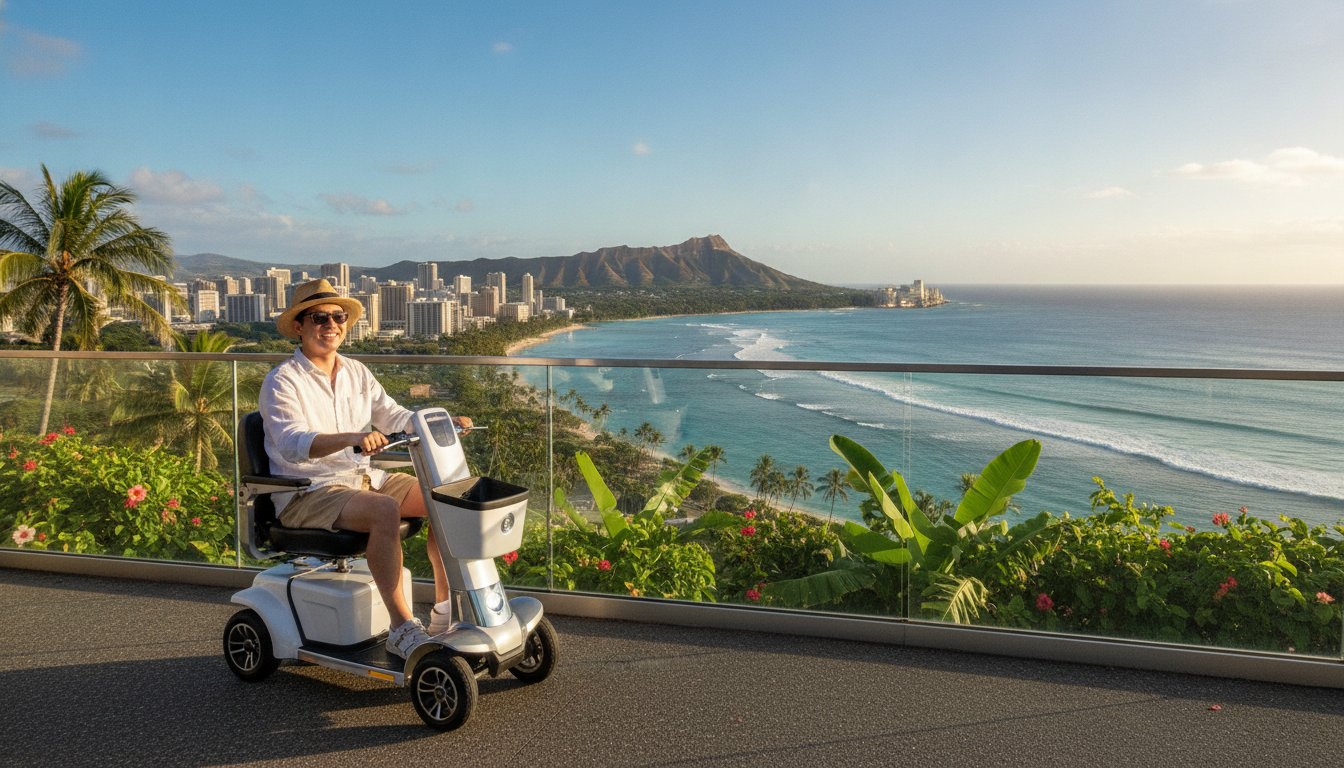
Imagine you're halfway through the sprawling grounds of Pearl Harbor, the sun is shining, and you're finally seeing the historic memorials you've dreamed of, only to notice your battery indicator dipping into the red. It's a stressful moment that can overshadow an entire Hawaiian vacation. Most travelers feel this same anxiety regarding mobility scooter battery life for long excursions, especially when manufacturer range claims don't always reflect the reality of Oahu's unique terrain or a full day of sightseeing. You deserve to focus on the beauty of the island, not the location of the nearest power outlet.
We're here to ensure your journey remains seamless and worry-free. This 2026 guide will show you exactly how to maximize your charge and choose the right equipment, such as the Go-Go Sport 4-Wheel Scooter, so you can confidently plan an eight-hour adventure. We'll explore the actual mileage you can expect on Honolulu's streets, provide practical tips for conserving energy in hilly areas, and highlight where you can stop to recharge while you take in the sights.
Think of your battery capacity in terms of "Amp Hours" (Ah). This is essentially the size of your fuel tank. A higher Ah rating means more energy is stored for your trip. For a standard Mobility scooter, this rating determines how many hours of continuous operation you can expect before needing a charge. When you're planning to see multiple sites in one day, understanding this number is the first step toward a stress-free experience.
Your physical weight and the gear you carry play a massive role in energy consumption. A heavier load requires the motor to work harder, which draws more current from the battery. If you're carrying extra bags for a day at the beach or souvenirs from a local market, your range will decrease. Your driving speed also affects the total distance. Traveling at maximum speed might get you to your destination faster, but it drains the battery much quicker than a steady, moderate pace. It's often better to cruise at a mid-range setting to preserve your power for later in the afternoon.
Traffic conditions in busy areas like Waikiki create another significant challenge. Frequent stopping and starting is far more taxing on the battery than cruising at a constant speed. Every time you accelerate from a standstill to avoid a pedestrian or wait for a crosswalk, the motor requires a surge of power. This stop-and-go pattern is one of the primary reasons mobility scooter battery life for long excursions can vary so significantly from the estimates you see in a manual. Planning a route with fewer intersections can actually help you stay on the move longer.
Most rental units use Sealed Lead Acid (SLA) or Gel batteries. SLA batteries are dependable and cost-effective, while Gel batteries handle deep discharges better and resist vibration. Lithium-ion is the modern standard for portable travel because it's lightweight and holds a charge longer. If you're flying into Honolulu, Lithium-ion batteries are often the best choice for portability, though you must ensure they meet specific FAA regulations. Always verify the Watt-hour rating with your provider before heading to the airport to ensure your equipment is flight-ready.
You might see a brochure claiming a range of "up to 15 miles," but in practice, you should plan for about 10 miles. Manufacturers test these devices under perfect conditions that don't exist on the streets of Oahu. Nominal range is a baseline measured on flat, indoor surfaces. Using accessories like headlights for an evening stroll or charging your phone through a USB port will also nibble away at your total mileage. By accounting for mobility scooter battery life for long excursions with a 30% safety buffer, you'll never find yourself searching for a plug when you should be enjoying the sunset.
Choosing the right model is the most important decision for your trip. You have to balance the need for a lightweight frame with the desire for maximum range. Portable models are fantastic for quick errands, but they often feature smaller battery packs to keep the weight down. If you're planning a full day out, you'll need to look at models specifically built for endurance. Maximizing your mobility scooter battery life for long excursions starts with selecting a machine that matches your itinerary.
The Go-Go Elite Traveller series is a popular choice for visitors who need to transport their scooter in a car trunk. These models typically offer a range of about 7 to 12 miles. While that's plenty for a morning at the mall, it might feel tight if you're exploring the entire length of Waikiki. If you're bringing your own device from the mainland, remember to check FAA regulations for mobility aid batteries regarding watt-hour limits before your flight. Renting locally often removes this logistical hurdle entirely.
Travelers often consider the Go-Go Sport 4-Wheel the gold standard for navigating Oahu. It features larger 18Ah batteries, providing a significant boost in mileage compared to more compact siblings. Beyond just the battery size, its design contributes to efficiency. Larger tires and a higher ground clearance mean the motor doesn't have to work as hard to navigate uneven sidewalks or small transitions. This efficiency allows for a range of up to 14 miles, which provides the confidence needed for all-day sightseeing.
The Go-Go Elite Traveller 3-Wheel is a champion of maneuverability. It's the perfect companion for navigating the tight aisles at Ala Moana Center or making short hotel-to-beach trips. However, portability comes with a tradeoff. These smaller batteries can struggle with steep inclines or rougher sidewalks found in older parts of Honolulu. If your path includes significant hills, you'll see your charge drop faster than expected.
For those planning extensive tours, the Go-Go Sport 4-Wheel is the superior choice. Its robust build handles the sprawling grounds of Pearl Harbor or a full day at the Honolulu Zoo with ease. The 4-wheel configuration offers enhanced stability on uneven paths, ensuring a smooth ride while preserving mobility scooter battery life for long excursions. If you're unsure which unit fits your plans, selecting the right rental model based on your destination is the best way to ensure a worry-free day.

Oahu offers breathtaking views, but its environment creates specific demands on your equipment. While we previously discussed battery capacity, the local climate is a separate variable that dictates mobility scooter battery life for long excursions. High tropical temperatures and the pervasive salt air of the Pacific can degrade performance if you aren't prepared. Understanding these local factors allows you to explore with the confidence of a resident expert.
Salt air is naturally corrosive. Over time, humidity and salt can create resistance in electrical connections or charging ports. This resistance makes the battery work harder to deliver the same amount of power. If you brought your own device from the mainland, you've likely already navigated the TSA rules for mobility scooters and security checkpoints. Once you're on the ground, a quick wipe of the charging port with a dry cloth each evening can help maintain a clean connection and prevent power loss.
The sidewalks in Waikiki also present a unique challenge. While generally accessible, they often feature textured surfaces or decorative paving that increases rolling resistance. This means your motor consumes more energy just to maintain a standard walking pace compared to the smooth, polished floors of a shopping mall. When you combine this with the crowds of pedestrians, the constant speed adjustments can drain your charge faster than a straight, clear path would.
Hawaii’s sun can quickly push battery temperatures into a range that triggers thermal throttling. This is a safety feature where the motor limits power to prevent permanent damage. To avoid this, always park in the shade when stopping for lunch or a rest. If you've just finished a long ride across town, wait at least 30 minutes before plugging into a charger. Charging a battery that is still hot from use causes significant internal stress and can shorten its overall lifespan.
The volcanic terrain of the island means you'll rarely find a perfectly flat path. Inclines are common around the base of Diamond Head and the outskirts of Honolulu. Even a modest 10-degree incline can double the energy draw from your motor. To conserve mobility scooter battery life for long excursions, try to plan routes that follow the coastline where the elevation is more consistent. When descending hills, use a steady, slow speed to prevent the motor's electronic braking system from overworking, which helps keep the electrical system cool for the next climb.
A successful day of sightseeing requires more than just a map; it requires a strategy for your equipment. The "Golden Rule" for any traveler is to always start your morning at 100% charge. Even if you only used the device for a short trip the night before, plug it in overnight. Batteries perform best when they are fully topped off, and this simple habit is the most effective way to protect your mobility scooter battery life for long excursions. You don't want to discover a half-empty tank when you're already miles away from your hotel.
It's also vital to understand that your battery gauge is a guide, not a guarantee. These meters measure voltage, which can dip temporarily when you are climbing a hill or accelerating. If you see the needle move toward the yellow or red while going up an incline, don't panic. Stop on a flat surface and wait a few moments; the gauge will often bounce back once the motor isn't under heavy load. To stay prepared, always carry your charger in the scooter’s basket. Many museums and cafes are happy to let you plug in for thirty minutes while you enjoy a meal or an exhibit.
When planning a Pearl Harbor scooter tour, expect to cover significant distances between the visitor center, the museums, and the memorial shuttles. While the grounds are accessible, the sheer size of the venue can be taxing on smaller batteries. Similarly, the Honolulu Zoo and the Waikiki Aquarium involve long treks where you may be moving at a very slow pace. In these crowded environments, turning off your power while you are stationary at an exhibit can save a surprising amount of energy over several hours. Major hubs like Ala Moana Center and the International Market Place offer plenty of seating near power outlets, making them ideal spots for "opportunity charging" during your lunch break.
If your battery gauge drops into the red zone and stays there, it is time to find a power source immediately. Don't try to "limp" home if you are far away. If the power is lost completely, check for a "freewheel lever" located near the rear motor to move the scooter manually. Having a local provider means you aren't alone if a battery fails. For the best experience on the island, book your reliable rental with a team that offers on-site support and delivery. This local backup ensures that a technical glitch won't end your vacation early.
Ensuring optimal mobility scooter battery life for long excursions is our primary mission. We don't just charge our batteries; we certify them. Before any piece of equipment leaves our Ewa Beach headquarters, it undergoes a professional capacity test. While retail-grade batteries found in many consumer units might lose their stamina after a year of light use, our rental-grade batteries are selected for their high-cycle durability. We use specialized discharge equipment to verify that every battery pack meets its original factory specifications under a simulated load. This rigorous process means you won't have to worry about a "tired" battery failing you halfway through your day.
Renting locally provides a level of security that national "big box" chains can't offer. We understand the specific demands of the Hawaiian environment, from the salt air to the afternoon heat. Our fleet features high-end models like the Go-Go Sport 4-Wheel Scooter, specifically chosen for its superior endurance and stability. Because we are based right here on the island, we maintain our equipment to withstand tropical conditions, ensuring that your motor and electrical connections remain in peak condition for your entire stay. You aren't just getting a scooter; you're getting a machine that has been prepared for the reality of Oahu's terrain.
Our family-owned approach means we treat your vacation as if it were our own. We take the time to customize your rental based on your specific plans, whether you're staying in a high-rise in Waikiki or a resort in Ko Olina. We don't just drop off the equipment; we provide a personalized setup and orientation to ensure you're comfortable with every control. For those looking for more detailed advice on exploring the island, our guide on Honolulu mobility for seniors provides excellent tips for navigating the city with ease and confidence.
We provide direct-to-hotel delivery and pickup services, making your transition from the airport to the resort completely seamless. Our team is dedicated to your freedom of movement, which is why we offer 24/7 support for any battery or equipment concerns during your rental period. If you have a question about your charging port or need a quick tip on maximizing your range, a local expert is always available to help. Don't let mobility concerns limit your Hawaiian experience. Reserve your high-end mobility scooter for your Oahu excursion today!
Exploring the island's most iconic landmarks shouldn't be limited by technical worries. By selecting the right equipment and practicing smart energy management, you can focus on the history of Pearl Harbor or the vibrant energy of Waikiki. Mastering mobility scooter battery life for long excursions is about preparation, from starting your day with a full charge to choosing a model with the endurance to match your curiosity. You now have the knowledge to navigate Oahu's tropical terrain and unique conditions like a local expert.
Locomotion Hawaii is proud to be locally owned and operated in Ewa Beach, providing the personal touch your vacation deserves. We guarantee reliability through rigorous multi-point battery health inspections on every unit in our fleet. To make your trip as seamless as possible, we provide direct delivery to all Waikiki hotels and cruise terminals. We are dedicated to ensuring your freedom and comfort from the moment you arrive until your final sunset on the beach.
Don't let anything hold you back from the experiences you've been dreaming of. Book Your Long-Range Mobility Scooter Rental Today and prepare for a journey filled with discovery. We look forward to being a part of your unforgettable Hawaiian story.
Most mobility scooters cover between 7 and 14 miles on a single charge. Portable models like the Go-Go Elite Traveller generally offer a shorter range of about 7 to 12 miles. Larger sport models with higher-capacity batteries provide more endurance for all-day trips. These estimates depend on flat terrain and moderate speeds, so it's wise to plan your route accordingly.
Yes, you can easily charge your scooter at any hotel in Waikiki using a standard 110V wall outlet. Most chargers are compact and portable, allowing you to plug in right in your room overnight. If you're staying in a boutique hotel, check for accessible outlets near the desk or bed. Always ensure the charging cable is tucked away to prevent a tripping hazard for other guests.
User weight is one of the most significant factors affecting mobility scooter battery life for long excursions. A heavier load requires the motor to work harder, which draws more current from the battery and reduces your total range. If you're near the upper weight limit of a specific model, it's smart to plan for about 20% less distance than the manufacturer's maximum estimate to avoid any surprises.
If your battery dies while you're out, you can use the manual freewheel lever to move the scooter. This lever disengages the motor so the wheels can turn freely for pushing. Once you're in a safe spot, contact your local rental provider for assistance. We offer 24/7 support for our guests, so we can help you find a power source or coordinate a replacement if you're stuck.
Yes, you should charge your scooter every night regardless of how much you used it during the day. Keeping the battery topped off prevents it from dipping into a deep discharge state, which can damage the internal chemistry over time. Starting every morning with a 100% charge is the best way to ensure you have maximum mobility scooter battery life for long excursions and total peace of mind.
While mobility scooters can handle a light tropical mist, you should avoid heavy rain and deep puddles. The electronic components and the tiller controls are sensitive to moisture. If you get caught in a sudden Oahu downpour, try to find cover immediately. Wipe down the seat and controls with a dry towel once you're back under a roof to prevent water from seeping into the electrical system.
A full charge typically takes between 8 and 10 hours. It's best to plug in your scooter overnight so it's ready for your morning activities. If you're doing a quick "opportunity charge" during lunch at a mall, even 30 to 60 minutes can give you a small boost. However, for the best battery health and performance, always aim for a complete and uninterrupted charging cycle whenever possible.
Rental batteries are highly reliable when they come from a provider that performs regular capacity testing. We rigorously inspect every battery pack to ensure it meets factory standards before it goes out to a guest. This professional maintenance means our scooters are specifically prepared for full-day tours of landmarks like Pearl Harbor. You can trust that your equipment is ready to handle the distance.
Join the hundreds of satisfied customers who trust us for their mobility needs.